If you have knee arthrofibrosis and have tried everything but nothing seems to work, you aren't alone.
In this post, I will introduce you to a real person named Marisol and her experience using the OrthoBike to reclaim her mobility from severe knee arthrofibrosis. If your battle with arthrofibrosis is hard, her story may give you hope that there is something that can help.
She improved her knee flexion from 60° to over 100° in just a few months of consistent home therapy.
Marisol's Incredible Journey with Arthrofibrosis
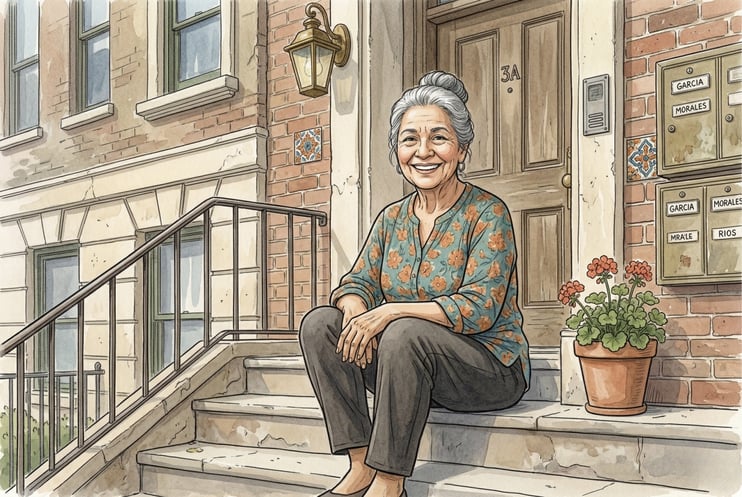
Marisol met us on the sidewalk in front of the stairs to her apartment. We had come to pick up her OrthoBike. As we walked up the stairs together, I was thinking,
This is not the same woman I met three months ago when I brought the OrthoBike to her! She is happy and I can’t tell from her gait that her knee was ever a problem.
But I knew her when her knee was a mess and she wasn’t happy.
TKR, arthrofibrosis, multiple procedures—worse off than before
She had a total knee replacement of her left knee, and then three more procedures because her knee developed a lot of scar tissue. Her doctor discharged her after the last procedure with only 45° of bend–there was nothing more he could do for her. He told her physical therapist that Marisol would be on painkillers and have limited mobility for the rest of her life.
Many of you who are reading understand her situation. She described her knee after the third procedure:
“Nothing was helping my knee, even injections. I was scared to death that my knee would never bend again. It was stiff and swollen and hurt really bad. I had a lot of depression.”
Her physical therapist had been using the OrthoBike with patients in his clinic for a few years. He recognized her case was so severe that she needed OrthoBike riding time every day. It would take tens of thousands of cycling revs to modify her knee's soft tissues. But he could not give her that opportunity in the clinic.
He also could not “go home” as her 24/7 home PT to treat her. So, he asked me to put an OrthoBike in her home.
I trained her how to systematically adjust the seat and pedal settings to give her incremental flexion angle increases. Then she was on her own, and I didn’t see her again for 3 months.
Riding the OrthoBike
Marisol pedaled the bike two times a day, adjusting the seat and pedals as her knee allowed. Within a week she added 10° to her knee bend, almost as much as she had gained in the past six weeks.
She added another 40°--a few degrees at a time--over the next three months.
Her physical therapist took the following measurements when she started home use and again about one month before she finished:
|
Test |
Day 1 |
Day 83 |
|
Sit-to-stand (30 seconds) |
5 |
24 |
|
Normal gait speed (ft/s) |
1.3 |
3.9 |
|
Fast gait speed (ft/s) |
na |
5.4 |
|
Active ROM |
60° |
101° |
In less than three months, Marisol made phenomenal improvement in her gait speed. She was using a walker at 1.3 feet/second at the beginning and progressed to age-normal walking speed of 3.9 feet/second. Her sit-to-stands improved almost 500%.
At the beginning of this story, I shared how happy Marisol was when I met her outside her home. Now you understand why. She had improved her strength, range of motion, and gait speed in three months of OrthoBike home therapy.
Takeaway
Multiple surgical interventions and the best physical therapy could not heal her severe case of arthrofibrosis. She restored her mobility herself by patiently pedaling the OrthoBike at home.
Why this matters
Marisol’s case was severe, a life-changing and devastating situation. Her surgeon could do nothing more for her. Her physical therapist knew she was beyond standard of care in-clinic therapy, but he also understood the value of at home therapy with the OrthoBike.
She trusted her physical therapist and was willing to try. Marisol did the experiment and proved for herself that OrthoBike was an effective tool to rehabilitate her arthrofibrotic knee. She overcame her disability and recovered her normal life.
Marisol's OrthoBike Riding Data
The graph below is taken from Marisol's own riding logs. You have never seen anything like it before, and I hope it throws open a window of possibilities for your own knee arthrofibrosis.
There are two important parts to her data: flexion and riding speed. To keep things simple for this summary post I will show you only that she incrementally progressed her flexion.
Flexion data
The graph below shows the step-wise progress of her flexion over 109 days of OrthoBike riding therapy, starting at 60° and ending about 110°.
I added the flexion angle in degrees to each step in the graph to help you follow the change in her knee’s bend. The bottom horizontal axis is the elapsed time in days from 1 to 109.
In another blog post I explain the idealized step-wise progression in flexion that OrthoBike makes possible (read it here).
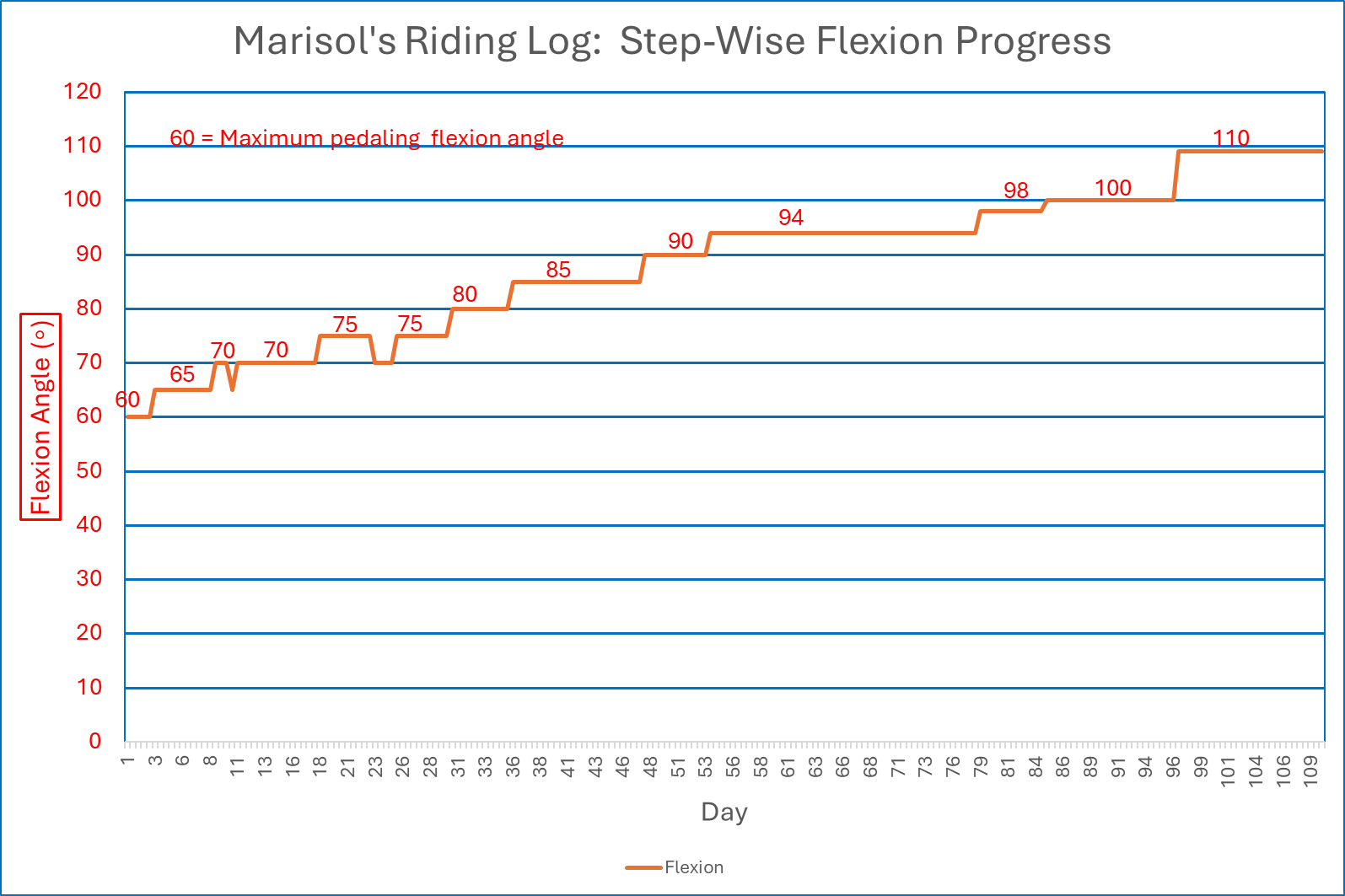
[History of maximum pedaling flexion from arthrofibrotic patient’s OrthoBike riding logbook. Angles in degrees (°).]
She did not measure her flexion. Each step up or down in the graph shows where she either moved the seat or lengthened/shortened the pedal cranks or changed both.
She listened to her knee. You can see that there was no consistency in the time she spent at each segment. And she experimented along the way with the seat and pedal settings. She learned how to make her own therapy decisions as she listened to her knee
Her therapy wasn’t programmed by a therapist, doctor, or computer.
Customization
Everybody’s flexion graph will be similar: step changes in flexion, and progress from low to high flexion. But nobody’s details will be the same: this program is customized by you to your knee’s needs.
A tool for you?
I hope you found Marisol’s story and data helpful as you consider your options and future.
OrthoBike is a tool that has helped many patients with limited range of motion resolve their problems by hard work over time–that they had no other way and hope of doing. It changes the game for patients suffering from knee arthrofibrosis.
It gives you the opportunity to get cycling therapy for your knee if it won’t bend enough to ride a conventional stationary bike. This is an option you did not have before OrthoBike.
Contact us to learn more about OrthoBike HERO or to reserve one for home use →
Click here for a technical review of the science behind OrthoBike.
Nothing in these posts is intended as medical advice or as a guarantee of any level or kind of outcome. The science of cycling in therapy and high- and low-intensity stretching are established. The physiological and psychological conditions of people vary. Consult with your medical care team.